Choosing suitable sports clothing and equipment is not just a matter of taste or budget. Materials, fit, sustainability regulations, and even the product’s end-of-life are now taken into account. This article compares the technical criteria that truly make a difference at the time of purchase.
Extended Producer Responsibility (EPR) and durability guarantee: what the regulations change for the buyer
Since January 1, 2022, producers of sports and leisure items (bicycles, rackets, skis, boards, fitness equipment) are subject in France to a distinct extended producer responsibility system separate from that of textiles. Technical clothing and shoes fall under the classic textile system.
This distinction has a direct consequence: the free take-back of used equipment varies depending on the seller and product category. Before purchasing, checking if the distributor offers a take-back service can guide the choice towards one brand over another.
Furthermore, starting from September 27, 2026, the European directive 2024/825 will require sellers to display a harmonized label when a commercial durability guarantee is offered. The goal is to regulate environmental claims and provide reliable information, beyond mere marketing arguments. Distributors like france-sports.fr are already listing ranges whose product sheets specify the composition and sustainability commitments.
Materials and breathability: comparison table by activity type
The choice of material determines comfort during exertion and the longevity of the garment. The table below summarizes the characteristics to prioritize according to the practiced discipline.
| Activity | Recommended Material | Main Property | Point of Caution |
|---|---|---|---|
| Running | Recycled polyester, breathable mesh | Quick moisture wicking | Flat seams to minimize friction |
| Yoga | Polyamide-elastane blend | Stretchability in all directions | Fabric must be sufficiently opaque when stretched |
| Fitness / weight training | Polyester with mesh inserts | Targeted breathability (back, armpits) | Fitted cut to follow movement without hindrance |
| Surfing / water sports | Neoprene (variable thickness) | Thermal insulation in aquatic environments | Flexibility at the shoulders for paddling |
| Hiking | Merino wool or water-repellent synthetic | Thermal regulation and quick drying | Abrasion resistance at the shoulder level (backpack) |
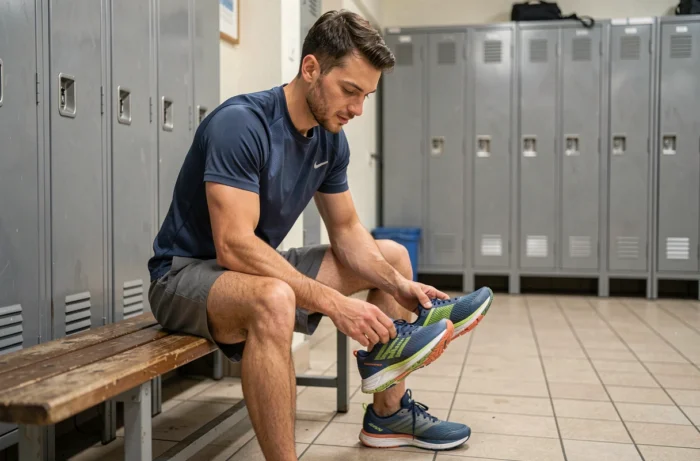
Cotton, often chosen out of habit, absorbs sweat without wicking it away. For intense sessions, synthetic fibers or merino wool outperform cotton in moisture management and drying time.
Sports shoes: selection criteria based on stride and terrain
Shoes represent the equipment category where a poor choice can lead to the highest costs, both in injuries and discomfort. Three parameters deserve analysis before any purchase.
- The type of stride (pronated, supinated, or neutral) determines the level of correction needed. A test in a specialized store or a video analysis of the stride can help make a decision.
- The practice terrain guides towards a smooth sole (road, gym) or a treaded one (trail, path). A trail sole on the road wears out prematurely, and a road sole on a wet path does not hold.
- Cushioning varies according to the runner’s weight and the distance covered. For long sessions, more generous cushioning reduces joint stress.
In contrast, for gym fitness or yoga, the priority is stability and the thinness of the sole. A shoe that is too cushioned can destabilize during lateral movements or balance exercises.
Jackets and mid-layers: adapting equipment to weather conditions
The three-layer system (base, insulation, protection) remains the reference for outdoor activities. The base layer wicks away sweat, the mid-layer retains heat, and the outer jacket protects against wind and rain.
A common mistake is to invest in an expensive jacket while keeping a cotton t-shirt as the base layer. The performance of the entire system depends on the weakest layer. A technical synthetic or merino base layer is inexpensive and transforms overall comfort.
For indoor sessions, a single breathable layer is sufficient. Adding multiple layers indoors can cause overheating that harms performance and accelerates fatigue.
Repairability and repair bonus: extending the lifespan of equipment
The repair bonus, already in place for clothing and shoes, covers common operations such as zipper replacement, mending snags, resoling, or repairing undone seams. The amount covered varies according to the type of intervention.
Repairing rather than replacing divides the cost and environmental impact. Inquiring with your eco-organization or local municipality can help identify the nearest authorized repairers.
When choosing equipment, checking for the availability of spare parts (laces, insoles, carabiners) is a reliable indicator of the manufacturer’s willingness to offer a repairable product.
The choice of sports clothing and equipment hinges on measurable criteria: material suited to the discipline, shoe matching the stride, coherent layering system, and repairability options. The European directive 2024/825, applicable from September 2026, will make this information more accessible through a harmonized durability label. It remains to consult product sheets with as much attention as one chooses their training program.