
A closet that overflows yet nothing to wear: we all know this situation. The problem rarely lies in the number of pieces, but in the lack of coherence between what we buy and what we actually wear. Building a style that lasts requires making concrete choices between second-hand, repairs, and new purchases, rather than following every fashion trend that pops up on a news feed.
Second-hand, repairs, or new purchases: making choices piece by piece
When faced with a damaged garment or a desire to buy, we have three options. We often handle them reflexively, while a quick decision can change the overall quality of the closet.
Second-hand works particularly well for structured pieces: coats, leather jackets, blazers, raw jeans. These garments retain their shape after several owners and their new cost is high. The Zalando report of 2025, cited by Samsara Eco, confirms that the savings achieved motivate as much as ecology in the choice of second-hand.
Repairs mainly apply to basics that we wear every week. A hem redone on well-cut trousers, a button replaced on an Oxford shirt, a sole re-glued on quality shoes: these actions extend the lifespan of pieces already tailored to our body and silhouette.
New purchases are justified for items that are not easily found second-hand or those that come into direct contact with the skin daily: underwear, swimsuits, technical socks. For these pieces, we look for good support, reliable composition, and precise sizing. There are also concrete ideas for organizing these choices on Lalie’s fashion blog, which details accessible and sustainable looks.
- Second-hand for high-value structured pieces (coat, blazer, wool dress): we save money and access cuts that we wouldn’t find in stores anymore.
- Repairs for everyday basics already fitted to our bodies: a tailored trouser is better than a poorly cut new one.
- New purchases limited to pieces in direct contact or to very specific size and body shape needs.

Fashion trends and sustainable wardrobe: what truly reconciles
Following trends is not incompatible with a wardrobe built to last. The key is to distinguish underlying currents from fleeting fashion effects.
An underlying current is, for example, the return of earthy colors or straight cuts on trousers. This type of trend spans several seasons and easily integrates into existing pieces. We can adopt it without buying everything new: an accessory or a single piece is enough to update a look.
In contrast, a very pronounced micro-trend (a neon color, an extreme cut) risks making a garment unwearable in a few months. If we fall for it, it’s better to look for it second-hand. The cost remains low, and we avoid storing a garment that we won’t wear again.
Adapting a trend to your silhouette
It is often said that one must “know their body shape” to dress well. In practice, it’s simpler than guides suggest. Two questions suffice: where do I want volume, and where do I not want it.
A woman who prefers to highlight her shoulders will choose a boat neck rather than a high collar, regardless of the current trend. Someone who wants to elongate their silhouette will favor high-waisted trousers with shoes that match the bottom. The garment adapts to the body, not the other way around.
Textile digital passport: what it changes for your purchases
The European regulation on the eco-design of sustainable products, which came into effect in July 2024, places textiles among the priority groups of the 2025-2030 work plan. A specific delegated act for textiles is tentatively scheduled for 2027.
In practical terms, this means that new garments will gradually incorporate a digital passport containing information on composition, origin, durability, and repair options. For the consumer, it’s a tool for direct comparison at the time of purchase.
This passport also changes the game for second-hand. A traceable garment retains its resale value better, as the buyer can verify the exact composition and care instructions. We move from a market where one must “trust the label” (when it still exists) to a market where information follows the garment throughout its life.
What it implies for the wardrobe
Opinions vary on this point, but several brands are already starting to display repairability information on their product sheets. Before buying a new piece, checking if the manufacturer indicates an estimated lifespan or an integrated repair service becomes a useful reflex.
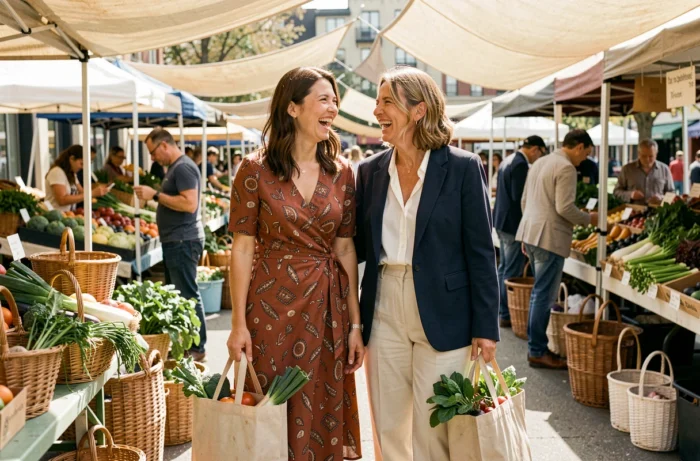
Building a personal style with pieces from different sources
A coherent style does not depend on the origin of the garments. One can mix a vintage blazer, a new thick cotton t-shirt, and trousers altered by a local tailor without the whole lacking unity.
Coherence comes from the color palette and proportions, not the labels. Three to four base colors that work well together (a dark neutral, a light neutral, one or two complementary shades) allow for almost all pieces in the closet to be combined.
- Choose your base colors based on what you already wear most often, not from a theoretical colorimetry guide.
- Test combinations by laying the garments flat before wearing them: you quickly spot the combinations that work.
- Keep one or two “signature” accessories (a watch, a belt, a type of shoes) that unify very different outfits.
French regulations are also starting to penalize ultra-fast fashion models. This context naturally pushes towards less frequent but more targeted purchases. Fewer pieces, better chosen, worn longer: this is the foundation of a personal style that does not depend on the collection calendar.
Building a sustainable and personal wardrobe is not an abstract project. It is a series of small decisions made in front of each garment: repair, buy second-hand, buy new, or simply pass. Style is built in these daily choices, not in a complete overhaul on a Saturday afternoon.