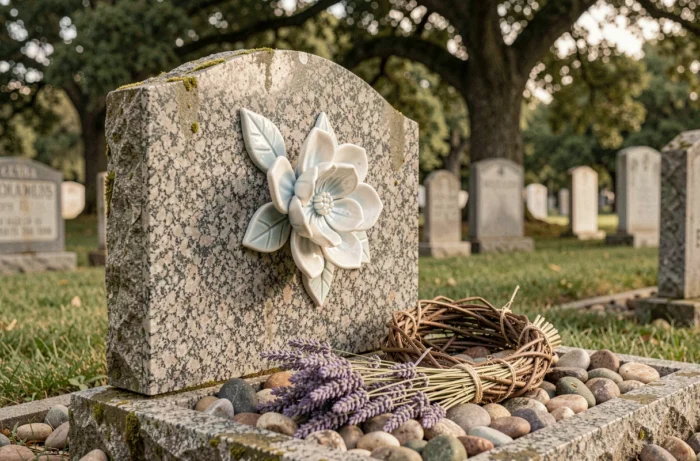
Decorating a grave with ornaments or ceramics involves dealing with constraints that most guides overlook: the cemetery regulations, the status of the concession holder, and the weather resistance of materials. Before choosing a porcelain plaque or a granite base, these parameters determine what can remain in place durably on the funeral monument.
Ceramics, porcelain, and granite: a comparison of materials for funeral ornaments
The choice of material determines the longevity of the decoration, its maintenance, and its cost. The three most commonly used families for plaques, medallions, and ornaments on gravestones have distinct characteristics.
| Material | Frost Resistance | Maintenance | Customization | Estimated Durability |
|---|---|---|---|---|
| Glazed ceramic | Average (sensitive to freeze/thaw cycles) | Gentle cleaning, no abrasive products | Photo printing, painted patterns | Variable depending on the glaze |
| Porcelain (medallion) | Good if fired at high temperature | Clear water, soft sponge | Portrait photo, engraved text | Several decades in a temperate climate |
| Granite | Excellent | Soapy water, soft brush | Engraving, gilding, bas-relief | Very long duration |
Ceramics are appealing for their rich colors and the possibility of reproducing a photograph. However, a glaze of insufficient quality can crack after a few harsh winters. High-temperature fired porcelain is more resistant but remains more fragile than a granite medallion in the event of mechanical shock.
Granite dominates for structural elements (base, vase, thick plaque). Its density makes it nearly insensitive to frost. When browsing funeral decoration ideas, it is noted that the current trend often combines a granite support with a porcelain medallion fixed on top, to combine strength and customization.
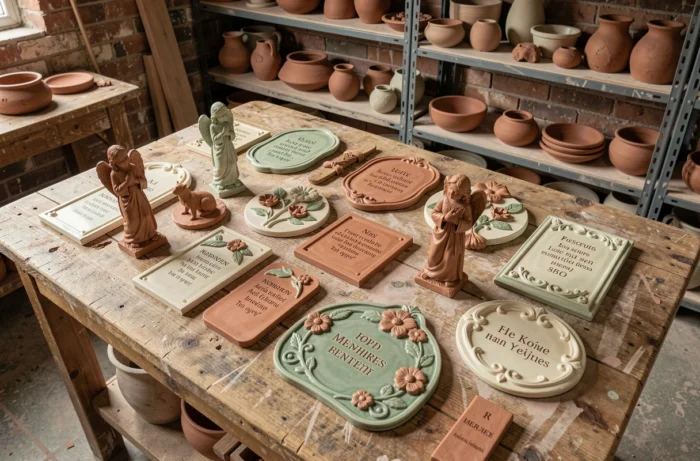
Cemetery regulations: what really limits the choice of ornaments
Each municipality sets its own rules regarding permitted funeral ornaments. There is no national list of objects allowed or prohibited on a grave. Dimensions of containers, height of elements, deposits in pathways: everything depends on the internal regulations of the specific cemetery.
This local disparity creates concrete situations that many families discover too late. A ceramic vase perfectly suited for a rural cemetery may be removed in another because it exceeds the regulatory height or encroaches on common space.
Memory garden and columbarium: specific restrictions
The spaces for scattering ashes do not accept the same decorations as a traditional concession. In some sites, only cut natural flowers are temporarily allowed. Permanent plaques, ceramics, and ornaments are prohibited. This is particularly the case in the Père-Lachaise scattering garden.
This distinction between traditional graves, columbariums, and memory gardens should be verified before any purchase. A custom-ordered porcelain plaque will be useless if local regulations prohibit it at the intended location.
Mayor’s authorization for inscriptions
Any inscription on a funeral monument must be submitted for prior approval by the mayor. This requirement applies to both direct engraving and permanently fixed plaques. Fixing an engraved ornament without this validation exposes it to removal.
Agreement of the concession holder: a prerequisite often overlooked
Placing a bouquet of flowers or a small object on a grave generally poses no problem. Modifying the monument is another matter. Fixing a plaque, engraving a name, or adding a permanent element may require the agreement of the concession holder or their heirs.
This point becomes particularly sensitive in extended families. A cousin who has a ceramic medallion engraved without consulting the holder may provoke a conflict, even a procedure to have the ornament removed. Checking who holds the concession before any permanent modification avoids unnecessary tensions.
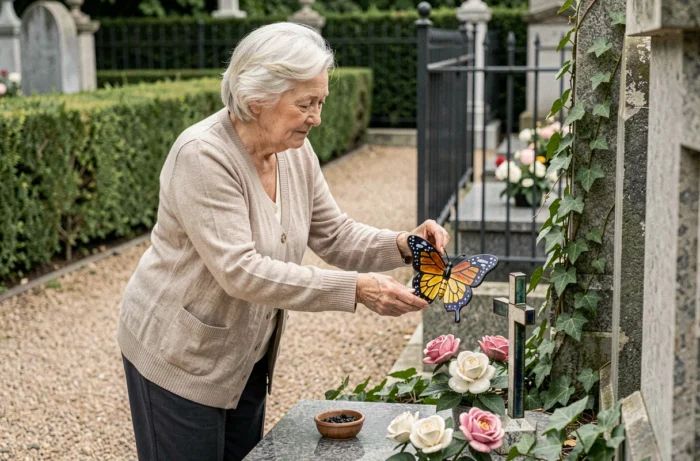
Maintenance of ceramics and ornaments on gravestones
Since July 1, 2022, pesticides are prohibited in cemeteries. This regulation renders obsolete maintenance recommendations that relied on herbicides or aggressive chemical cleaners. The maintenance of funeral ornaments now relies on gentle methods.
Glazed ceramics and porcelain medallions are cleaned with clear water and a non-abrasive sponge. Granite can withstand a bit of neutral soap and a soft brush. Metallic elements (bronze, brass) require specific treatment to limit oxidation.
Here are the appropriate maintenance gestures according to the type of ornament:
- Ceramics and porcelain: rinse with warm water, wipe with a soft cloth, avoid any acidic product that could damage the glaze
- Granite and stone: brush with neutral soapy water, rinse thoroughly, never use a descaling product
- Metal elements (bronze, brass): apply a suitable protective wax, avoid prolonged contact with standing water
- Artificial flowers made of fabric or ceramic: dust regularly, replace as soon as colors fade
Criteria for choosing a durable funeral ornament
The material is not everything. The location of the grave (exposure to wind, sunlight, proximity to trees) directly influences the degradation of ornaments. A ceramic placed under a lime tree will suffer from sap deposits and moss much faster than an identical piece in full sun.
The method of fixation is as important as the material. A medallion simply glued is less resistant than an element screwed or embedded in the stone. For personalized funeral plaques, a granite base with mechanical fixation offers the best durability over time.
- Check the cemetery regulations before any purchase of permanent ornament
- Prefer high-temperature porcelain or granite for climates with frequent frost
- Opt for mechanical fixation rather than simple gluing for plaques and medallions
The choice of a funeral ornament hinges on three concrete parameters: compatibility with local regulations, the material’s resistance to the region’s climate, and the agreement of the concession holder. Without these three prior checks, even the most beautiful ceramic may not stay in place.