
During a lock repair, settling the bill often occurs in a stressful context, sometimes late at night or on a weekend. The individual must choose between credit card, cash, or bank transfer, and each payment method has different implications in case of a dispute over the billed amount.
Irrevocability of payment and lock repair: the trap to know before settling
The rarely discussed point in guides on locksmithing concerns the difficulty of recovering a sum paid afterwards. Regardless of the method used, a payment validated on-site is difficult to contest if the customer accepted the amount at the time of the intervention.
For credit cards, a dispute generally does not serve to contest an amount that the cardholder has authorized themselves. It pertains to loss, theft, or a transaction made without the account holder’s consent. A disagreement over the price of a replaced cylinder does not fall under this framework.
The bank transfer, especially instant ones, poses an even clearer problem. Once executed, the instant transfer is almost irrevocable, and recovering funds in case of a false bank account number or commercial pressure remains very complicated. The individual who pays under the pressure of an urgent locksmith loses their main margin of maneuver. You can delve deeper into the question of accepted payment methods by locksmith professionals by checking out this article that details common practices.
The only real protection, regardless of the payment method, remains the signed estimate before the intervention, the detailed invoice, and the payment receipt. These three documents form the basis of any subsequent claim.
Credit card to pay a locksmith: the dominant reflex and its limits
The credit card is the most commonly used payment method in France for everyday transactions, including home service provisions. Its use during a lock repair can be explained by three practical reasons.
- The individual does not need to prepare a sum in cash, which matters when a slammed door occurs at an unexpected time.
- The portable payment terminal (TPE) has become common among tradespeople, including locksmiths responding to emergencies.
- The transaction leaves a timestamped banking trace, useful in case of a dispute over the amount or the service performed.
The main limitation lies in network coverage. In some basements, underground parking lots, or rural areas, the TPE may not have a signal. The locksmith may then request an alternative payment, often in cash.
Keeping the credit card receipt and the invoice is the reflex to have. Without these documents, a complaint to the bank or a consumer association loses credibility.
Contactless payment and limits
Contactless payment generally works up to a limit set by the issuing bank. For a repair whose amount exceeds this threshold, the PIN code will be requested. In itself, this does not change consumer protection, but entering the code sometimes gives a false sense of final validation of the amount. It is not the PIN code that legally binds, but the acceptance of the estimate.
Cash for a lock repair: a declining but not trivial use
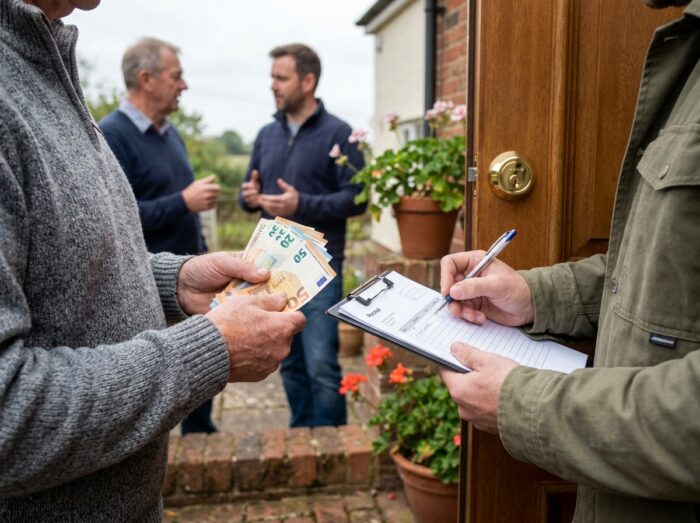
Cash withdrawals by card have declined for the second consecutive year in France, both in volume and amount. This trend makes the generic advice “keep cash for an emergency” less and less realistic. Many individuals simply no longer have a significant amount of cash on hand or at home.
However, cash payment is still accepted by the majority of locksmiths, and it has a concrete advantage: the customer knows exactly the amount they are handing over. No deferred withdrawal, no silent overcharge.
The risk, however, is the lack of traceability. A less scrupulous professional may provide an incomplete invoice or not issue one at all. Without an invoice, no recourse is possible with the departmental directorate for the protection of populations (DDPP).
Legal limit for cash payments
In France, an individual can pay a professional in cash within the limit set by regulations. Beyond this threshold, payment must be made through a traceable method (card, transfer, check). Always demanding a detailed invoice protects the consumer, even for cash payments.
Instant transfer to pay a locksmith: the new option to watch
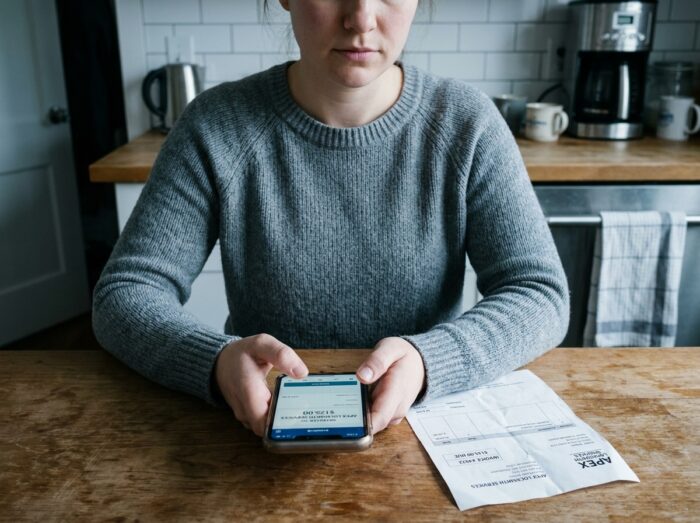
Instant transfers are gaining ground as an alternative to card payments during urgent repairs. Since January 9, 2025, its pricing cannot exceed that of a classic transfer. And since October 9, 2025, banks in the euro area must allow its issuance. This regulatory evolution, stemming from European regulation (EU) 2024/886, changes the game for home service provisions.
In practice, a locksmith can provide their bank account details on-site and receive payment in a matter of seconds, even in the evening or on weekends. The instant transfer works without a payment terminal, which eliminates dependence on mobile network coverage.
Specific precautions for transfers
The irrevocability of instant transfers makes it a tool to handle with caution. Before validating the transfer, two checks are necessary.
- Compare the amount displayed on the banking app with that indicated on the signed estimate, line by line (travel, labor, parts, cylinder).
- Verify that the bank account details provided correspond to the business name or the locksmith’s SIRET number, and not to a third-party account.
- Keep a screenshot of the transfer confirmation in addition to the paper or PDF invoice.
A transfer sent to a false bank account, under the pressure of a dishonest operator, represents a nearly certain loss. Banking recourse exists but rarely succeeds when the client initiated the operation themselves.
Invoice and estimate: what protects the individual regardless of the payment method
The payment method is just one aspect of the settlement. The real protection for consumers relies on the documentation of the service. A detailed estimate, signed before the work begins, commits the locksmith to the price. The invoice, provided at the end of the intervention, must specify the exact nature of the parts installed, the labor rate, and any travel fees.
Without a signed estimate, contesting an invoice becomes an administrative and legal obstacle course. Whether the payment is made by card, in cash, or by transfer, it is this document that underpins any claim.
The choice of payment method during a lock repair thus depends less on personal preference than on the level of traceability sought. The credit card offers the best compromise between practicality and proof. The instant transfer gains relevance thanks to recent European regulation, but its irrevocable nature requires heightened vigilance. Cash, declining in usage, remains accepted but exposes the individual more in the absence of an invoice.