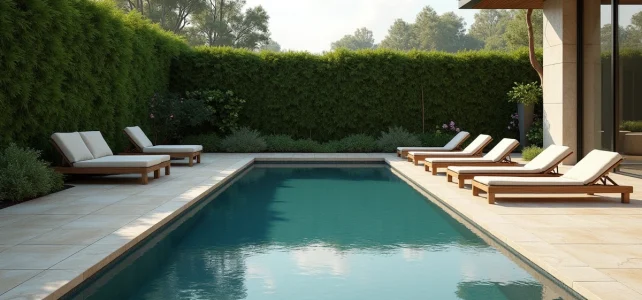
The choice of a residential pool rarely hinges on the shape or color of the liner. What separates a successful project from a regrettable one is the mastery of technical constraints upfront: hydraulics, soil structure, thermal management. Designing a pool at home requires addressing these issues before thinking about garden furniture.
Hydraulic management and filtration: the invisible foundation of the pool
A poorly sized hydraulic system creates dead zones where water stagnates. We recommend calculating the recirculation flow based on the exact volume, not a rounded estimate. The complete recycling time must remain below the threshold set by the filtration group manufacturer; otherwise, disinfection loses effectiveness.
The choice between sand, cartridge, or diatomaceous filtration depends on the pool’s volume and the quality of the supply water. Diatomaceous filtration offers the highest filtration fineness, but it requires regular maintenance of the filtering elements and incurs higher operating costs.
For projects where water consumption is an issue, optimized backwashing cycles and rainwater recovery systems help limit losses. In light of the recurring water restrictions in recent years, these devices are no longer a luxury but a matter of technical common sense. You will find concrete feedback and technical sheets in the pool section of Inside Out, which documents these approaches by pool type.
Coating and pool structure: liner, reinforced membrane, or tiling
The coating determines durability and maintenance costs over ten years. The classic liner remains the most common choice for in-ground pools, with a lifespan that varies depending on thickness and UV exposure. The thicker PVC reinforced membrane is more resistant to deformation and is suitable for freeform pools.
Tiling (ceramic or glass mosaic) offers a premium finish and superior longevity but requires a perfectly stable concrete structure. On clayey or movement-prone soil, the risk of cracking increases. We observe that many projects neglect the preliminary soil study, leading to costly repairs after two or three seasons.
Criteria for selecting the coating
- The nature of the ground: stable soil allows for tiling, while loose soil directs towards the reinforced membrane that absorbs micro-deformations
- The use of the pool: a family pool with children favors a non-slip coating, whereas a lap pool may opt for a smooth surface with low roughness
- The long-term maintenance budget: the liner is replaced every eight to twelve years on average, the reinforced membrane lasts longer, and tiling often exceeds two decades if installed flawlessly
Pool deck and landscaping: materials and integration into the garden
The pool deck is not just a simple peripheral sidewalk. It serves a technical role: draining runoff water, providing thermal comfort underfoot, and resisting chlorine and UVs. Composite wood has largely replaced exotic wood in this area, with better dimensional stability and almost no maintenance.
Natural stone (travertine, sandstone) remains a premium design option. It provides a mineral aesthetic that integrates well into a Mediterranean or contemporary garden. However, some limestone stones can stain easily when in contact with treatment products. We always recommend a water-repellent treatment before commissioning.
Vegetation around the pool
The plants selected for the pool area must meet specific constraints: no abundant deciduous foliage (which clogs the skimmers), no invasive roots (which threaten the shell or pipes), and a tolerance to chlorinated splashes.
Ornamental grasses, certain varieties of lavender, and dwarf palms check these boxes. Evergreen hedges around the perimeter ensure privacy while limiting wind exposure, which reduces surface evaporation from the pool.
Natural pool or classic pool: a long-term commitment
The natural pool, chlorine-free and with biological filtration, appeals due to its ecological aspect. The technical reality tempers the enthusiasm: the lagooning area (where purifying plants filter the water) occupies at least the same surface area as the swimming pool. On a modest-sized plot, this type of project becomes difficult to realize.
The biological stabilization of a natural pool takes several months. During this phase, the water may turn green, which discourages unprepared homeowners. Maintenance differs radically from a classic pool: no chemicals, but regular monitoring of the plant ecosystem and periodic cleaning of the filtration area.
For intensive family use, the classic pool with salt or UV treatment remains more predictable. The natural pool is better suited for contemplative use or as part of a comprehensive landscaping project where the pool is integrated into a water garden.
Comfort and equipment: heating, lighting, cover
Air-water heat pump heating dominates the residential market. Its efficiency depends on the outside temperature, making it less effective below certain thresholds. For regions with mild winters, it offers the best compromise between operating cost and efficiency.
Submersible LED lighting transforms the nighttime ambiance of the pool and relaxation area. Color-changing spotlights allow for creating atmospheres, but warm white lighting around the perimeter is sufficient for safety and visual comfort.
- Bar covers or rolling shutters limit nighttime thermal losses and reduce the consumption of treatment products
- A low telescopic shelter extends the swimming season by several weeks without altering the garden’s aesthetics
- Pool automation systems (remote control of filtration, pH, and heating) simplify daily monitoring and detect anomalies before they degrade water quality
A well-thought-out pool project stands out for the coherence between the pool, its landscaped environment, and its technical equipment. The choices made regarding filtration, coating, and deck significantly influence long-term satisfaction, far more than the style of furniture or the shape of the pool.