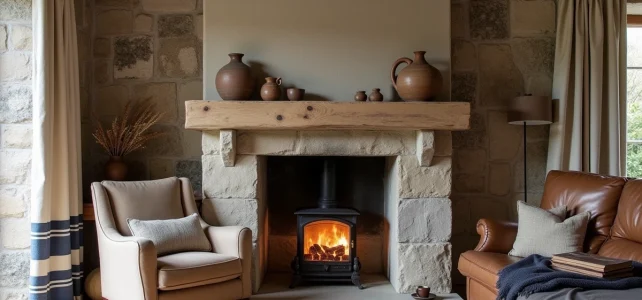
A Breton house is recognizable even before you step inside. The granite walls, colorful shutters, and slate roof that shines in the rain. However, as soon as you push the door open, the challenge begins: how to maintain its soul without turning the interior into a maritime museum?
The warm Breton home is not just about placing a miniature lighthouse on the mantelpiece. It relies on choices of materials, colors, and volumes that respect the existing structure while meeting today’s needs.
See also : Ideas and Inspirations for a Warm Minimalist Home Decor
Coastal humidity and thermal comfort: the real starting point
Before choosing a sofa or a wall color, you must address a problem that decoration magazines carefully avoid: humidity is the primary enemy of Breton comfort. Proximity to the ocean, frequent rains, thick stone walls that store water: without appropriate treatment, even the most beautiful interior will smell musty within a few months.
Controlled mechanical ventilation (CMV) with double flow is a valuable ally. It renews the air without cooling the room, which is important when granite walls take time to warm up. To complement this, a lime plaster on the interior walls allows the stone to breathe while naturally regulating humidity. Lime absorbs excess moisture when the air is saturated and releases it when the air dries out.
Recommended read : Tips and Inspiration for Creating a Fulfilling Gardening Space at Home
Have you ever noticed that fresh stone smell in old longères? It often indicates that the walls are functioning properly. A cement plaster, on the other hand, traps water and causes capillary rise. If you are renovating an old Breton house, exploring the solutions offered around the house on the Jolie Breizh site can help identify the right reflexes before moving on to decor.
Stone, wood, and linen: the material palette of an authentic Breton interior
Exposed granite remains the strongest signature of a Breton house. A whole wall left in raw stone in the living room creates a visual depth that no wallpaper can match. The key: don’t overdo it. One stone wall is enough to anchor the room’s identity. The other walls benefit from a light plaster (off-white, pearl gray, sand) that reflects the natural light, which is often scarce in Brittany.
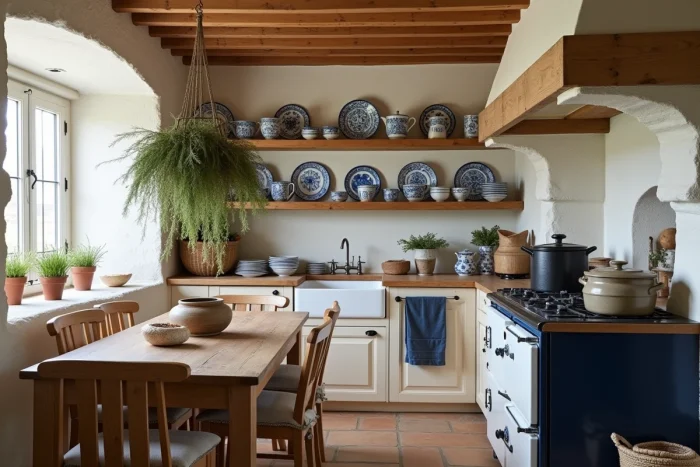
Wood is present everywhere, but not just any wood. Oak and chestnut are the historical species of the region. They can be found in exposed beams, flooring, and country furniture. Chestnut naturally resists humidity, making it particularly suitable for houses near the coast.
For textiles, raw linen or hemp provides that slightly irregular texture that evokes coastal life without falling into marine clichés. A thick linen curtain filters light while insulating the windows, which are often small in older constructions.
- Exposed granite limited to one or two walls to avoid a cave effect, complemented by light lime plasters
- Beams in oak or chestnut left raw or simply brushed, never varnished in gloss
- Textiles in linen, hemp, or local wool for cushions, curtains, and throws
- Solid wood furniture with simple lines, inspired by Breton buffets and farmhouse tables
Colors of a Breton house: beyond navy blue
The most common reflex is to paint in navy blue and white. This is a casting error. The true Breton color palette is inspired by the landscape, not postcards. The moors offer shades of heather (old rose, muted mauve), gorse brings a dull yellow, and moss on the walls suggests deep greens.
A warm living room in Brittany can revolve around a sage green on the woodwork, a soft terracotta wall behind the stove, and textiles in mustard or rust tones. These warm colors compensate for the external grayness without betraying the spirit of the place.
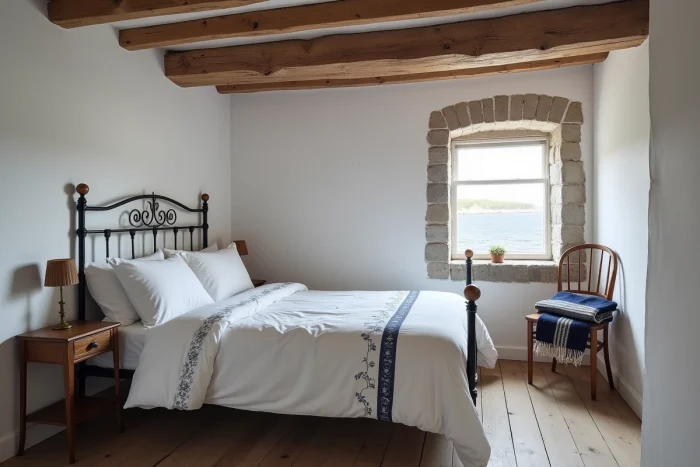
Why avoid the total blue and white look? Because it turns any room into a seafood restaurant decor. Contemporary Breton decoration moves away from this register to draw from the colors of the interior countryside: earth, forest, stormy sky. Blue remains welcome, but as an accent: a ceramic vase, a corduroy cushion, an antique frame.
Reconciling Breton authenticity and contemporary design
The tension between heritage and modern comfort often plays out on three specific points: lighting, heating, and workspaces.
Natural light in thick walls
Traditional Breton houses have narrow windows designed to withstand the wind. Enlarging an opening in a granite wall requires the intervention of a specialized mason and, in coastal areas, a permit that complies with local architectural rules. A simpler alternative: multiply low light sources (table lamps, brass sconces) rather than relying on a single ceiling fixture.
Heating and atmosphere
A wood stove or insert in the existing fireplace remains the most coherent choice with the spirit of the house. It heats efficiently in rooms with low ceilings, typical of longères and fishermen’s houses. A clean-burning model reduces emissions while keeping the ritual of fire, which remains the heart of Breton domestic life.
Office and telecommuting
Many Breton houses, purchased as second homes, are becoming full-time living spaces. A nook under the stairs, an alcove in a bedroom, or a renovated shed can accommodate a workspace. The trick: a solid wood desk and a comfortable chair are enough to create a functional corner without distorting the room.
- Favor light fixtures made from raw materials (brass, wrought iron, ceramics) that blend into the country style
- Insulate the attic from the inside with wood wool, compatible with old walls
- Create a workspace in a secondary volume to preserve living areas
A warm Breton house cannot be decreed with a decoration catalog. It is built room by room, starting from the existing structure, respecting the original materials, and accepting that the light will always be different from that of a Parisian loft. It is precisely this soft light, filtered by rain and granite walls, that makes these interiors so special.