
Shipping a package via Mondial Relay requires adherence to specific limits regarding dimensions and weight. Exceeding these thresholds, even by a few centimeters, can result in refusal at the pickup point or return to the sender. The rules vary depending on the chosen service, and certain subtleties, such as the calculation of volumetric weight, can change the game for bulky items.
Volumetric weight Mondial Relay: the calculation that sellers overlook
Most shippers focus on the actual weight of the package and barely check its dimensions. However, volumetric weight is the criterion that triggers the most refusals or surcharges from carriers at pickup points.
The principle is simple: the carrier compares the actual weight to the volumetric weight and then charges based on the higher of the two. For Mondial Relay, volumetric weight is calculated by multiplying length, width, and height (in centimeters), then dividing the result by a divisor coefficient specific to the carrier.
A lightweight but bulky box, such as a lampshade or a set of cushions, can thus fall into a higher pricing tier without the sender anticipating it. This discrepancy between actual weight and volumetric weight particularly affects sellers of decorative items, upholstery textiles, or disassembled furniture parts.
To check your maximum package dimensions Mondial Relay before shipping, you need to measure the closed box, including tape, and not just the item itself. Poorly fitted packaging adds unnecessary centimeters that inflate the volumetric weight.

Size and weight limits according to Mondial Relay service
Mondial Relay offers several delivery modes, each with its own dimensional constraints. Confusion often arises because the limits differ between a drop-off at a standard pickup point and a home delivery via the professional offer.
Standard shipment at a pickup point
The most commonly used service by individuals and small e-commerce merchants remains delivery to a pickup point. The constraints apply to both the maximum weight, the length of the longest side, and the total perimeter of the package (often referred to as “girth” in logistics jargon).
- The maximum allowed weight is generally limited to 30 kg for a standard shipment at a pickup point, beyond which the package is systematically refused.
- The length of the longest side must not exceed a threshold set by the carrier, which varies according to updates to their general conditions.
- The total perimeter of the package (length + 2 times the width + 2 times the height) has a distinct ceiling, which penalizes cubic or very wide shapes.
A package can comply with the maximum weight while being refused because its perimeter exceeds the limit. This scenario frequently occurs with medium-sized square boxes.
Professional home delivery
The home delivery offer, reserved for e-commerce merchants with a professional contract, accepts heavier and bulkier packages than the pickup point network. Automatic lockers, whose network has expanded in recent years, impose more restrictive dimensions related to the size of the compartments.
For a seller who regularly ships bulky items, the distinction between these services determines the choice of delivery method offered to customers.
Packaging and package security Mondial Relay: what causes refusals
Beyond raw dimensions, the quality of packaging is part of the acceptance criteria. A deformed box, insufficient tape, or a package whose shape prevents stacking may be refused at drop-off.
An oversized package for the item increases the risk of breakage and volumetric weight simultaneously. Choosing a box that fits the content, with appropriate internal cushioning, reduces both issues at once.
- The box must be rigid, without signs of moisture or tearing. Reused boxes are accepted as long as they are in good condition and do not bear any old shipping labels.
- The tape must seal all openings. A package closed only by flaps without adhesive will be refused.
- Fragile items require sufficient cushioning (kraft paper, foam, polystyrene chips) to ensure nothing shifts if the box is turned upside down.
- Shipments containing liquids must be packaged in a leak-proof bag inside the box, with sufficient absorption in case of leakage.
Field returns show that the majority of disputes with Mondial Relay do not concern exceeding weight limits but rather packaging deemed non-compliant at the time of drop-off.
Bulky but lightweight shipments: circumventing perimeter limits
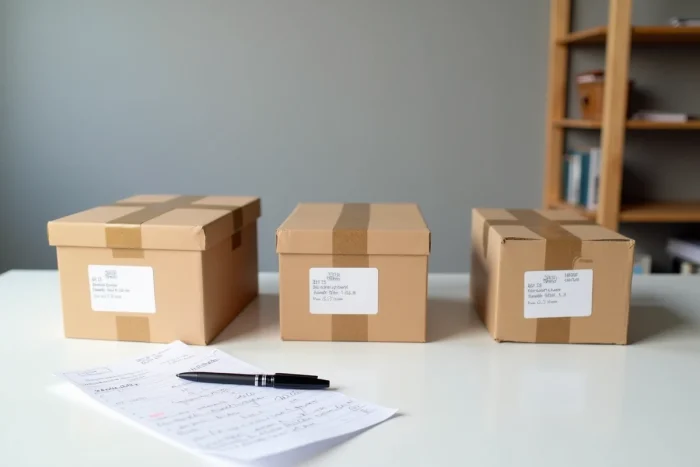
Inflatable mattresses, duvet covers, tents, or flat-pack furniture pose a specific problem: their actual weight is low, but their volume causes the perimeter to exceed the allowed limit. Mondial Relay then charges based on volumetric weight, which can make shipping sometimes more expensive than a heavy but compact package.
Compressing the item before packaging remains the most effective method to stay within limits. Vacuum compression bags significantly reduce the volume of textiles or foam. For flat-pack furniture, removing the manufacturer’s cushioning elements and repackaging the parts in a smaller box may suffice.
When compression is not possible, consider splitting the shipment into two separate packages, each complying with individual limits. The total cost of two shipments may sometimes be lower than that of a single oversized package handled by a traditional courier.
Some multi-carrier shipping platforms allow for automatic comparison of Mondial Relay’s dimensional thresholds with those of other providers. Check the limits before choosing the box, not after, to avoid unpleasant surprises at the pickup point counter.
The last reflex to adopt: measure the closed and cushioned package, not the flat box. A box inflated by internal cushioning often exceeds the dimensions stated by the box manufacturer by two to three centimeters. It is these centimeters that can shift a shipment from the standard rate to a simple refusal.