
The calculation of green space area on slabs is not limited to measuring a vegetated area and adding it to the areas of bare soil. The PLU regulations apply weighting coefficients that reduce the ecological value of these surfaces compared to natural soil. Understanding this calculation mechanism determines the compliance of a construction or development project, especially since the Climate and Resilience Law of 2021 accelerates the fight against soil artificialization.
Weighting coefficient on slabs: the ecological value is not that of natural soil
The Biotope per Surface Coefficient (CBS) is the central calculation tool in most recent PLUs. Its principle is based on a simple idea: each type of surface receives a coefficient that reflects its actual contribution to the water cycle, biodiversity, and thermal regulation.
A green space in bare soil, meaning topsoil in direct contact with the layers of natural soil, receives a coefficient of 1. A green space on a slab, on the other hand, is assigned a lower coefficient, varying according to the thickness of the substrate.
- Vegetated slab with at least 30 cm of topsoil: coefficient of 0.7 in most regulations (Grand Dax, Lempdes, and many intercommunalities).
- Vegetated roof or terrace with less than 30 cm of substrate: coefficient generally lowered to 0.5 or less, depending on the local PLU.
- Impermeable surface (concrete, asphalt, mortar paving): coefficient of 0, regardless of the presence of planters or pots placed on it.
The calculation formula is as follows: multiply each type of surface by its coefficient, add the results, and then divide the total by the area of the plot. The resulting CBS must meet or exceed the threshold set by the relevant PLU zone.
To determine the applicable rules for your land, including the requirements regarding the surface of green space on slabs, the reference document remains the zoning regulation of your municipality’s PLU or PLUi.
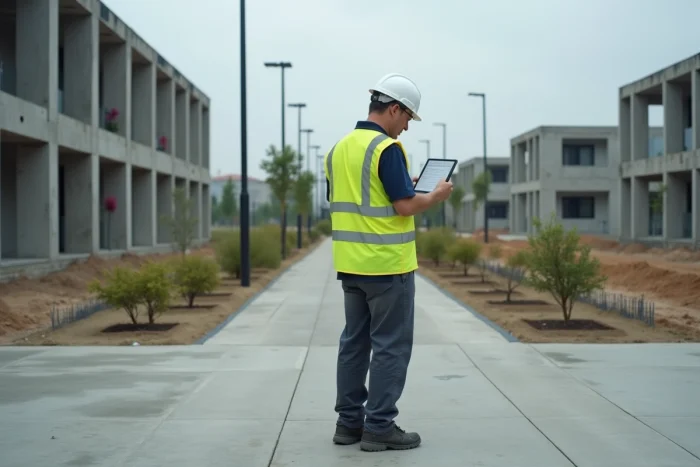
Concrete calculation of CBS on a plot with a vegetated underground parking lot
Let’s take a plot of 500 m². The project includes a covered underground parking lot with a vegetated slab of 200 m² with 35 cm of substrate, 150 m² of garden in bare soil, and 150 m² of building with a non-vegetated roof.
The calculation is as follows:
Garden in bare soil: 150 x 1 = 150. Vegetated slab (more than 30 cm): 200 x 0.7 = 140. Impermeable roof: 150 x 0 = 0. Total eco-developable area: 290. CBS = 290 / 500 = 0.58.
If the PLU imposes a minimum CBS of 0.50 for the area, the project is compliant. However, if the local threshold is set at 0.60, it falls short by a few points, and the project proponent will need to either increase the substrate thickness on the slab (to check if a higher coefficient applies locally) or convert part of the roof to extensive greening.
What the CBS does not say about the actual quality of the soil
The coefficient of 0.7 assigned to a green space on a slab remains a regulatory convention. It does not guarantee that vegetation will thrive there in the same way as in bare soil. The thickness of the substrate directly conditions the possible plant palette: 30 cm allows for grass and low perennials, but deep-rooted shrubs require 60 cm or more.
Field feedback diverges on this point. Installations on permeable cellular slabs show interesting resilience to drought episodes, with root infiltration in the cells maintaining moisture that bare soil loses more quickly during periods of water stress. This observation, documented on shock-absorbing soils like Securiplay, nuances the idea that bare soil is systematically superior in a tense climatic context.
ZAN Law and PLU: why requirements on slabs will tighten
The Climate and Resilience Law of August 22, 2021 (law no. 2021-1104) sets a target of 50% reduction in net soil artificialization by 2031. Intercommunal PLUs are gradually integrating this framework, which directly modifies how surfaces on slabs are accounted for.
Until now, many regulations simply distinguished between bare soil and “other.” The current trend encourages communities to refine categories, distinguishing permeable cellular slabs from impermeable slabs, and placing greater value on thick substrates.
Article L.151-22 of the Urban Planning Code allows PLUs to impose a minimum share of non-impermeable or eco-developable surfaces. In Île-de-France, this provision affects about 40% of municipalities, according to the DRIEAT report. Projects that compensate for their built areas with permeable vegetated slabs align better with this logic than those that merely use planters placed on a roof terrace.
Common errors in calculating vegetated surface area on slabs
The first error is to account for the gross surface area of the slab without applying the weighting coefficient. A developer who lists 200 m² of “greening” in their building permit application while the CBS only recognizes 140 m² equivalent risks rejection or a request for additional documents.
The second error concerns the measurement of substrate thickness. Some regulations require a minimum of 30 cm to grant the coefficient of 0.7, but this thickness is understood to be excluding the drainage layer. Counting the drainage layer within the 30 cm leads to an overestimation of the eco-developable surface.
The third concerns pools and basins. Several PLUs assign them a coefficient of 0.5 as semi-open surfaces. Including them in the CBS calculation as green spaces on slabs, with a coefficient of 0.7, skews the result.
Check before submitting the permit
The CBS is not a universal calculation. Each PLU can modify coefficients, add categories, or remove certain weightings. Consulting the zoning regulation before any calculation remains the only reliable method. Calculation sheets published by certain intercommunalities (Grand Dax, Lempdes) provide a good starting point, but they reflect their own regulations, not those of your municipality.
The convergence between ZAN objectives and local CBS makes these verifications all the more necessary as regulatory updates accelerate. A coefficient valid at the time of submitting a planning certificate may have changed by the time of the building permit if the PLU has been revised in the meantime.