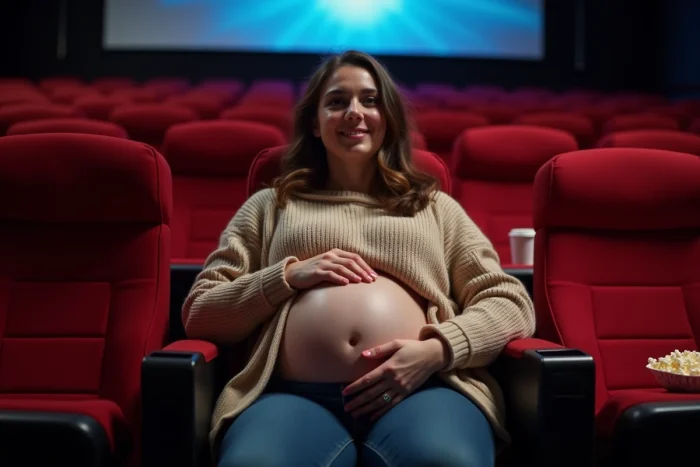
Going to the cinema during pregnancy raises questions that are rarely addressed by doctors during follow-up consultations. The sound volume in theaters, immersive technologies like 4DX, and the increasing length of films raise concrete concerns about the comfort and safety of the fetus. The available data allows for some guidelines, even if certain areas remain unclear.
Low-frequency vibrations and pregnancy: what the European regulation changes
Beyond sound volume, low-frequency vibrations, infrasound, generated by the sound systems of modern theaters also deserve attention, particularly during action or science fiction films.
The European directive 2025/123/EC on public health in performance venues now mandates monitoring of low-frequency vibrations in addition to noise. Specific limits aim to protect the fetus from prolonged exposure during special effects films. This regulation marks a notable evolution compared to previous standards, which only considered overall sound levels.
In practice, theaters equipped with immersive technologies (4DX, IMAX, Dolby Atmos) produce vibrations that the viewer physically feels. Pathé also reminds in its 4DX safety instructions that 4DX screenings are not recommended for pregnant women. This restriction is not an excessive precaution: the moving seats, air jets, and jolts put stress on the body in a way that is incompatible with pregnancy, regardless of the trimester.
To delve deeper into the general precautions related to this outing, you can consult the recommendations for going to the cinema while pregnant according to Doctinews, which detail possible adaptations based on the stage of pregnancy.
Sound volume in theaters: the thresholds that matter for the fetus
In France, the regulatory limit for sound volume in cinemas is set at 102 dB. This ceiling, designed for the general public, does not take into account the auditory sensitivity of the fetus. Several health organizations recommend that pregnant women avoid environments exceeding 85 dB for extended periods.
Amniotic fluid dampens some of the sounds transmitted to the fetus. However, this attenuation varies by frequency: low frequencies pass through amniotic fluid more easily than high-pitched sounds. An action film projected at high volume therefore exposes the fetus to a real sound level that is difficult to estimate precisely.
Surveys conducted with 500 French midwives report a rising trend in complaints of temporary tinnitus among pregnant women after screenings longer than 90 minutes at high volume. These professionals recommend auditory breaks every 45 minutes. No study has yet established a precise risk threshold for the fetus, which encourages prioritizing screenings at moderate volume as a precaution.
“Relax” screenings at reduced volume: a practical option for pregnant women
Since 2024, several cinema chains in France, including Pathé and Gaumont, have increased the number of screenings at reduced sound volume, kept below 85 dB. These programs, sometimes called “relax” or “sensory adapted” screenings, respond to a growing demand for moderate sensory experiences, driven by families and pregnant women.
This trend, documented by the CNC (National Center for Cinema and the Animated Image) in its annual report published in March 2026, reflects a market evolution. The number of reduced volume screenings has significantly increased over the past two years. Field feedback varies on this point: some independent theaters have not yet adopted these formats, and availability varies greatly by city.
To identify these screenings, the most reliable method remains to contact the cinema directly or check its website. Reservation apps do not always indicate the expected sound level.
Physical comfort in theaters: adapting the outing to the trimester of pregnancy
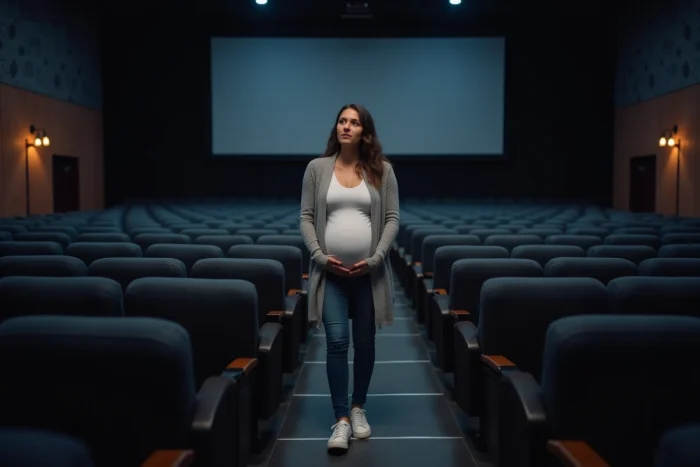
Beyond sound, the question of physical comfort deserves attention. The average length of films tends to increase, and sitting in a cinema seat for more than two hours can become uncomfortable starting from the second trimester.
Some practical guidelines for organizing the outing:
- Choose a seat at the end of the row to easily get up, whether to go to the restroom or simply stretch your legs
- Prefer daytime screenings, which are less crowded, where seat selection remains open and evening fatigue does not add to discomfort
- Bring a lumbar cushion or a small support for the lower back, as cinema seats are not designed for postural adjustments related to pregnancy
- Avoid films longer than two hours in the third trimester, as venous compression related to prolonged immobility increases the risk of heavy legs and edema
The RunPee app, mentioned by many expectant mothers on English-speaking forums, indicates moments in the film where the plot slows down enough to allow for a break without losing track. A simple tool that avoids having to choose between comfort and enjoyment of the film.
Thrilling films and fetal stress: what we know and what we don’t
Horror films and suspense thrillers trigger adrenaline and cortisol spikes in the viewer. The question of the impact of these stress hormones on the fetus is the subject of research, but the data do not allow for a formal prohibition on a particular film genre.
What we know: the fetus reacts to maternal emotional variations with changes in its heart rate. What we don’t know: whether a one-time exposure of two hours to a stressful film produces a measurable effect on development, as opposed to chronic stress whose effects are better documented.
The midwives surveyed in recent French studies do not formally discourage suspense films. They rather suggest listening to one’s own reactions: if a genre typically provokes marked anxiety, it’s better to lean towards a comedy or light drama during pregnancy.
The cinema remains an accessible and enjoyable outing in every trimester, provided the choice of theater and film is adapted. Reduced volume screenings, checking the technologies used in the theater, and a few practical adjustments are enough to transform this outing into a real moment of relaxation, with no identified risk for the pregnancy.