
A small garden better supports its plants when it also has a name. Naming an outdoor space, even if reduced to a few square meters, gives it an identity that goes beyond mere decorative function. The name of a garden establishes an intention, guides the choices of plants, and creates a reference point in the daily life of the household.
Function of the garden name: what a word changes on a plot
Assigning a name to a small garden has a tangible effect on how one cares for it. A named space becomes a project: we talk about the “Bee Square” or the “Wild Slope” as we would speak of a room in the house. The name acts as a framework that filters decisions regarding planting, furniture, and maintenance.
Read also : Ideas and Inspirations for a Warm Minimalist Home Decor
This approach takes on an additional dimension when the garden is part of a biodiversity program. Labels like “LPO Refuge” or “Nature Oasis” encourage gardeners to adopt a name consistent with a charter for welcoming wildlife and absence of pesticides. The name then serves as a communication tool, on a sign at the entrance or on social media, to choose a garden name with Une Fleur Un Jardin while considering this committed dimension.
On social media platforms, hashtags like #mytinygarden or #balconjungle show that the name of the garden unites a community. Documenting the evolution of a named place generates more interactions than a simple photo album of anonymous plants.
Recommended read : Ideas and Inspirations for a Cozy Breton Home

Three creative methods to find an original garden name
Online name generators, designed for businesses, offer standardized combinations that lack personality. For a personal small garden, the naming method deserves more thought.
Start from local botanical vocabulary
The first approach is to identify the dominant or oldest plant in the garden, then build the name around it. A lavender bed in a corner of the terrace gives “The Lavender Close.” An old climbing rose on a shared wall inspires “The Rosa Arbor.”
The Latin botanical name adds a distinctive touch without complicating pronunciation. “Hedera” for an ivy garden, “Salvia” for a herb square: these short terms sound good and are easily remembered.
Associate the name with the geography of the place
A sloping garden, a nook between two walls, a south-facing balcony: the physical configuration of the space provides rich material. Here are some concrete ideas:
- “The Hollow Garden” for a plot below, sheltered from the wind by nearby buildings
- “The Solar Terrace” for an elevated space that captures light all day
- “The Green Passage” for a long garden along a path, typical of terraced houses
- “The Flowering Wall” when vegetation colonizes a stone or cinder block wall
These names describe the place as much as they designate it. A visitor immediately understands what the space looks like.
Tell a personal or family story
The third method draws from the history of the household. The first name of a gardening grandparent, a travel memory, a childhood reading: a narrative name transforms the garden into an extension of family memory. “Emile’s Vegetable Garden” or “Kyoto Corner” carry an emotional weight that automatic generators do not replicate.
Garden name and urban biodiversity: a choice that engages
Shared garden initiatives and urban micro-forests have evolved the practice. The name of the garden no longer serves solely to please oneself at home. It asserts an ecological positioning.
Labeling a garden as “Pollinator Refuge” or “The Living Wasteland” publicly announces a management style. The name becomes a visible commitment to the local green framework. This activist dimension of the name, linked to ecological corridors and biodiversity, far exceeds the decorative puns found in most online inspiration lists.
For labeled gardens, the coherence between the name and the program charter enhances credibility. A garden named “The Oasis for Tits” that displays the LPO Refuge sign tells a story that is readable at a glance.
Test and validate the name of your small garden
A good garden name meets three practical criteria before being engraved on a slate or displayed on social media.
- Pronounceability: the name should be said aloud without hesitation. If a neighbor stumbles over the word, the name is too complex
- Length: two to four words are sufficient. Beyond that, the name loses impact and becomes difficult to use as a hashtag or reference in conversation
- Uniqueness: a quick online search can verify that no other garden, blog, or association is already using the same name in the same region
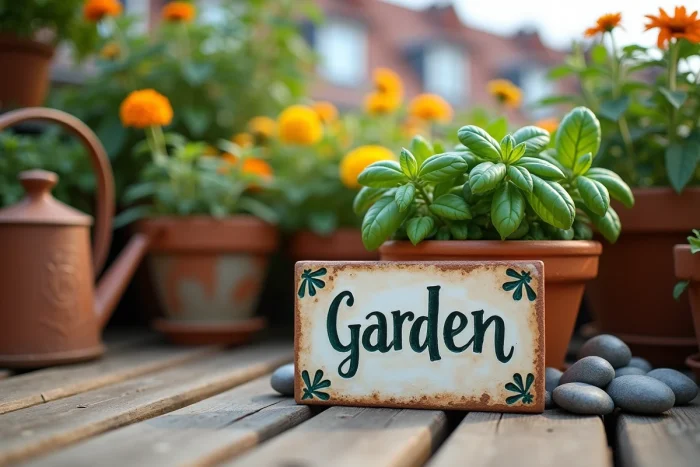
The simplest test remains to write it on a temporary support (a slate, a painted piece of wood) and leave it in place for a few weeks. A name that seems appealing on the first day may become tiresome after fifteen days. The trial period avoids regrets.
Some gardeners change names over the seasons or as the garden evolves. A space that transitions from a vegetable garden to an ornamental garden can legitimately change its identity. The name does not need to be permanent to be useful: it structures a stage of the garden, and the next stage may call for a new word.