
A volume of 3 m3 corresponds to a cube of about 1.44 m on each side. In practice, this capacity is found in small rental vans and in some entry-level storage units. Understanding what this space can actually hold avoids unpleasant surprises during a partial move or a one-time transport.
Transporting fragile high-tech items in 3 m3: the forgotten use case
Guides on the volume of 3 m3 almost always talk about boxes, furniture, and dishes. One scenario slips under the radar: transporting sensitive electronic equipment like a folding electric bike, a drone, or photography gear.
Read also : How to Terminate Your LMNP Status: Essential Steps and Practical Tips
These items pose a different problem than furniture. Their unit volume is moderate, but electronic components are sensitive to shocks, pressure, and humidity. A folding electric bike frame, once folded, occupies about half a cubic meter. A drone in its hard case takes up the space of two standard boxes. The remaining space can accommodate batteries (to be transported horizontally, with contacts protected) and accessories.
To utilize the 3 m3 without damaging the electronics, three precautions make a difference:
Further reading : How to Choose the Ideal Senior Residence in France: Tips and Practical Advice
- Secure each device in its original packaging or in custom-cut foam, then block everything against a wall of the vehicle to eliminate lateral movement.
- Place moving blankets between rigid objects and the cases of drones or photography equipment to absorb vibrations on the road.
- Store lithium-ion batteries in a separate fireproof bag, away from heat sources, and ensure that the terminals are protected by insulating caps.
With this method, a single load of 3 m3 can contain a folding electric bike, two drones with their accessories, a box of computer equipment, and still have room for about ten standard boxes to fill the remaining space. To better visualize what can be transported in 3 m3, it’s important to think in successive layers rather than random stacking.

Usable volume vs gross volume: why 3 m3 never equals 3 m3
The stated capacity of a van or storage unit is a gross volume measured from wall to wall. The actually usable volume is always less, for several reasons.
The wheel arches in a van eat into the floor space. The irregular shapes of furniture create air pockets that are impossible to fill. According to the French Federation of Vehicle Rentals, discrepancies between gross volume and the volume actually loaded are common and often underestimated by individuals.
Counting on about a quarter loss is a realistic baseline for a mixed load (boxes plus furniture). In other words, in 3 m3 gross, it’s better to plan as if you have just over 2 m3 usable. This margin prevents you from ending up with items that won’t fit on the day.
The trap of long items
A bookshelf, a clothing rack, or a curtain rod often exceeds 1.80 m. However, the interior length of a 3 m3 van varies by model. Some vans offer less than 2 m of usable length. Measuring the interior diagonal of the vehicle remains the only reliable way to check if a long item will fit diagonally.
Typical loading for a partial move in 3 m3
A volume of 3 m3 corresponds to the contents of a large room or a very sparsely furnished studio. Here’s a concrete example of a realistic load:
- A single bed mattress, rolled or compressed in a cover, which occupies a reduced volume but takes up the full height once laid flat against a wall.
- A dismountable desk, an office chair, and a small TV unit: these three disassembled items represent about 0.5 m3.
- About fifteen standard boxes (approximately 55 x 35 x 30 cm), which is the content of a bedroom and part of the kitchen.
- Two to three bags of clothes or vacuum-sealed covers, slipped into the gaps.
Systematically disassembling furniture allows for a third more space compared to transporting it assembled. Table legs, shelf boards, and bed frames can be stored flat along the walls, freeing up the center of the vehicle for boxes.
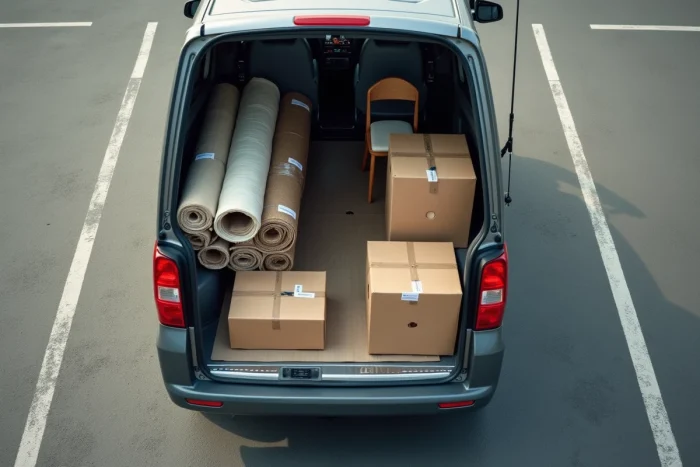
3 m3 van or storage unit: two uses, two constraints
The same volume does not impose the same rules depending on whether it is a moving vehicle or a static space.
Constraints of the van
The total authorized weight limits the loading well before the volume. On most 3 m3 vans, the payload caps between 500 and 700 kg. Filling the entire volume with boxes of books or tools can exceed this limit. Checking the payload listed on the vehicle’s registration document avoids violations and mechanical risks.
The distribution of weight also matters. Placing the heaviest items at the back, above the rear axle, stabilizes the vehicle and reduces the risk of tipping in turns.
Constraints of the storage unit
A 3 m3 unit often presents itself as a narrow space in height. Access is from only one side. Stacking the heaviest boxes at the bottom and the lightest on top protects the contents, but you also need to think about accessibility: items needed first should be placed near the door.
The ventilation of the unit influences the preservation of stored items over several weeks. Electronic devices, fabrics, and paper do not tolerate stagnant humidity well. A passive dehumidifier or silica gel packets placed between the boxes can limit damage.
Three cubic meters are sufficient for a bedroom move, temporary storage between two homes, or the transport of fragile technical equipment. The key remains to measure before loading, disassemble anything that can be, and always think in usable volume rather than displayed volume.