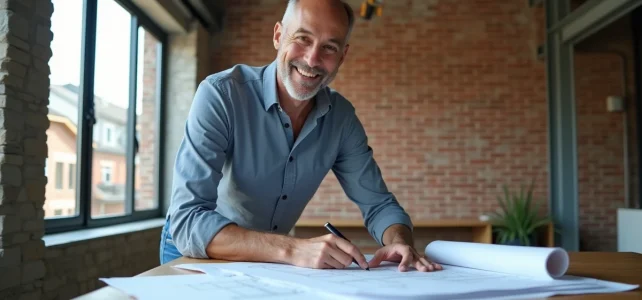
The law requires the use of an architect as soon as the floor area of a construction exceeds 150 m². This obligation, often seen as a constraint, actually hides unknown opportunities to maximize the value and quality of a property.
In the face of increasing regulations and the administrative jungle, the partnership between the project owner and the architect becomes a true lever to transform a real estate project into concrete success. From the design stage, every choice guided by a solid professional avoids missteps, anticipates market pitfalls, and paves the way for tangible results.
Read also : How to Launch and Succeed in Your Profitable Online Business in 2024
Why choosing custom architecture transforms your real estate project
An architect does not just draw plans or stack square meters. They reveal the uniqueness of each plot, capture light, and enhance every volume. While the builder’s house reproduces models, the custom house shapes a property that meets your expectations. This approach goes beyond appearance: it focuses on functionality, energy performance, and asset enhancement.
The custom house is not just a shelter, but a space designed for your uses, your story, your environment. The architect assesses the property’s strengths, imagines technical or spatial solutions that break the mold, and anticipates the evolution of the family or professional project. In the case of a rental investment, this approach enhances the attractiveness and profitability of the property: a tenant will naturally be drawn to a thoughtfully designed, sustainable, and comfortable home.
Further reading : Everything You Need to Know to Succeed in Real Estate Investment and Manage Your Wealth Well
Custom architecture caters to both primary residences and projects undertaken by a real estate investment company (SCI) or commercial spaces to be transformed. The SIA Architecture website is full of examples where each realization interacts with its environment, adapts to regulatory constraints, and supports new uses. In this approach, the trust between the architect and the client becomes the true driving force of the project.
Here are three direct benefits of personalized architecture:
- Personalization: every aspect of the project meets a concrete need, far from off-the-shelf solutions.
- Optimization: no square meter is wasted, every constraint becomes an asset.
- Enhancement: the property increases in value, remains appealing over time, and withstands the test of years without becoming outdated.
Choosing custom architecture gives your project a strong identity, an adapted use, and a real long-term added value.
What are the key steps to building with an architect?
The success of a construction relies on the rigor of the process and the support of the project owner at each stage. It all begins with a consultation visit: analysis of the land, evaluation of architectural potential, identification of constraints. This first contact initiates the dialogue and lays the groundwork for a demanding collaboration.
Next, signing the architect’s contract frames the mission. This document details the nature of the interventions, the fees (percentage, flat rate, or time spent), deadlines, responsibilities, and insurance. The architect then conducts a feasibility study to ensure that the project complies with urban planning regulations and that the budget is coherent. The design phase follows: sketches, detailed plans, descriptions, and estimates structure the entire project, whether for new construction or an extension.
Obtaining the building permit is a turning point. The architect prepares each document for the administrative file, then develops the consultation file for companies to select the craftsmen. The schedule becomes clearer, companies are chosen, and work contracts are signed.
During the construction, the architect remains actively involved: they oversee the site, monitor the quality of the construction, and support the project owner until the completion of the work. This supervision ensures the coherence of the whole, the compliance of the works, and adherence to deadlines. The result: a solid, enhanced project, ready to withstand the test of time.

Understanding your rights, obligations, and advantages before you start
Before starting, it is essential to clearly understand the legal framework of your real estate project. The project owner must take out construction damage insurance, which facilitates the rapid repair of issues covered by the ten-year guarantee. This protection covers major defects in solidity for ten years and ensures the longevity of your property and your peace of mind.
The floor area determines the need for an architect. From 150 m², the intervention of a professional registered with the Order of Architects is required in France. However, regardless of the project, advice remains invaluable: the CAUE (Council of Architecture, Urban Planning, and Environment) in your department can guide you, decipher local rules, and recommend reliable professionals.
If you are considering a individual house construction contract (CCMI), take the time to analyze each clause: this contract governs the relationship with the builder, details the guarantees, penalties for delays, and payment terms. For a renovation or extension, a specific analysis is necessary: budget compliance, adaptation to your needs, anticipation of regulatory and technical constraints. Rights and obligations revolve around the protection of your home, compliance of the works, and risk management.
At the end of the construction, it is not just a house that stands, but tangible proof that every square meter thought out, every choice made, builds much more than just a property: a true heritage that reflects your image.